This winter has been brutal. The record cold temperatures we had in December and January and several major snowstorms (the last one – the historic Blizzard of ’26 – just yesterday) make me long for spring. My seedlings have all sprouted. First was the thyme, followed by leeks, snapdragons, sage and peppers. The marigolds I sowed on February 20 are also sprouting, and this morning, I saw the first kale seedling (also sown on February 20) making its appearance.
I started my first seedlings today – leeks, sage, thyme, snapdragons and two kinds of hot peppers (Thai and Tennessee Spice, the latter was a freebie from Sand Hill Preservation Center, and I have no idea what that pepper even is). The leeks and hot peppers are for myself, the snapdragons (mostly) for the communal flowerbeds, and the sage and thyme are for the new community garden at the Mildred Haley Housing Development in Jackson Square. They are currently undergoing a redevelopment, which will include creating community gardening spaces, and I will start seedlings (flowers and herbs) this spring for the borders of that garden.
Not looking like much right now but I find it most exciting: Seeds all tucked in, under grow lights and with a heat mat to warm the soil.
Every year in the garden is different, but 2025 was a weird and in part downright disappointing year in my community plot. There were many fails, but also some highlights.
Planting diagram for 2025Harvest, August 25
Fruiting crops (tomatoes, cucumbers, peppers, eggplants). It was a strange year for tomatoes. I harvested my first tomato (Stupice) on July 23, and then had a fantastic, very steady supply all through the month of August. I harvested at least two pounds every other day. Which was great. But then, production dropped off sharply by early September, and with the early tomatoes done, the Ananas Noire and Black Krim developed some type of rot. I had to pull the plants and only had a few more slowly ripening Ailsa Craig and Brimmer all through fall. I had enough tomatoes to preserve some. I made a couple of batches of slow-roasted tomatoes, and I also pickled some green cherry tomatoes (those were from the communal flower bed). The cucumbers did well. This year, I only planted mildew-resistant varieties (Diva, a slicer and Max Pack, a pickling cucumber), and that really made a difference. I had more pickling cucumbers than slicers, and that is just fine with me. The cucamelons did okay. Not enough plants to really have a significant harvest. For peppers, it was Thai peppers only. They were tiny but super potent. I had two plants in the plot and one in a container on the porch. I ended up drying them. No eggplants his year.
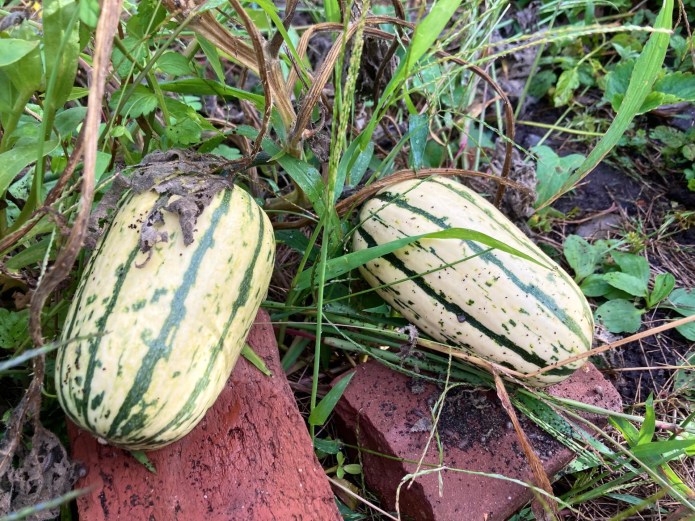
Delicata squash, September 28
Squash. 2025 marked the first year I successfully grew Delicata squash. Hallelujah! As with the cucumbers, I only grew mildew-resistant squash varieties, and that really seemed to pay off. On the downside, all my squash plants took forever to grow and set flowers. Therefore, they set fruit very late, and the squash I harvested were much smaller than normal. I had one zucchini plant, and it did not do great. It grew very slowly and set fruit surprisingly late, but it was also a very different variety than usual.
Porch radishes, May 6
Root vegetables. I only grew radishes (French Breakfast) and only on the back porch. Those were fantastic as usual, and they always make me so happy in early spring. I sowed the fall beets too late in late summer and then (because of traveling and other issues in the fall) was not able to thin them and take care of them properly. No carrots this year.
Rabbit-proofed kale and chard (plus lavender, shiso and parsley in the front), August 23
Brassicas. I again only planted kale this year, several plants of Meadowlark, a tasty green curly variety. It did great as usual, but also needed to be fenced in as the rabbits were very interested. I noticed far fewer aphids this year. Perhaps this was due to the calendulas which grew nearby? Calendula is known to serve as an effective trap crop.
Lettuce harvest (Black Seeded Simpson),June 28
Greens and lettuce. I had a row of Swiss chard, which grew super slow (except for one plant for some reason), so I only had a small harvest. I planted lettuces in containers on my porch and also (fenced in) in the plot, and they all did really well. The spring arugula on the back porch did great too. No spinach or fall greens.
Legumes. I did not grow any peas or beans this year.
Some of the hardneck garlic after being cleaned, August 1
Alliums. It was a fantastic year for garlic. My garlic is getting bigger every year, because I always save the largest heads as seed garlic. I also planted shallots in the spring and had high hopes as they were sprouting nicely. I ended up with only three (!) shallots as most of them were eaten by critters, which was a bit of a surprise. I did not think I needed to fence them in, but the rabbits seemed to enjoy the tender shallot shoots. I will try shallots again next year, this time protecting them with chicken wire. For the first time, I made garlic scape powder in addition to garlic scape pesto. A very good idea.
Sweet potato, June 28
Sweet potatoes. First time ever trying to grow sweet potatoes and it was a formidable fail. To be fair, I only had one plant (it was a pilot project after all), but I don’t think I took care of it properly. I did not hill it, etc. I harvested about six or seven small tubers, some of them with holes thanks to some soil-dwelling critters. I contemplated curing those tubers but ended up composting them. It would have been too much of an effort.
Calendula, June 12
Flowers. This year was all about calendula (more posts on this later). But I also grew strawflowers (which I truly loved and used around the house and incorporated in this year’s garlic braid) and zinnias. And there were marigolds and nasturtiums of course. The borage came up late and never really flowered. I only had three surviving dahlia tubers, which went into the communal flower bed, as did the alyssum, gomphrena, okra, and many more zinnias and strawflowers I grew from seed.
Basil, June 19
Herbs. My herbs did well this year. In the plot, I had several rows of Thai basil and Italian basil, the latter interplanted as usual with the tomatoes. I made several batches of both Thai basil pesto and regular basil pesto. I also had a sage plant in the plot, which unfortunately died. The parsley in the plot did well this year. On my porch, I had three parsley plants as well as Italian basil and Thai basil and other kitchen herbs.
Ginger, April 28
Ginger. Big fail. I honestly am not sure what happened. It had a very promising start, but I may have put it outside too soon. It just turned yellow and died. I am not sure I will try again next year.
Rhubarb, May 2
Perennials. I harvested the first real rhubarb this year (meaning several rounds) after I had put the plant in in 2022. It is finally mature enough, yay! I made a super delicious rhubarb crisp, and we also made strawberry-rhubarb compote a couple of times. I am so happy that I finally can harvest enough rhubarb again.
Back porch Zinnia, July 20
Porch. As in previous years, I grew mostly herbs and flowers on my back porch. This year, I had parsley (3 plants), Italian basil (2), Thai basil (2), and smaller containers of rosemary, thyme, sage, chives and lavender. There was one large container of flowers, which went from spring bulbs to zinnias. I also grew radishes, arugula and lettuce (all in the spring), and Thai peppers in the summer. The Thai peppers were interplanted with Thai basil and nasturtium. And there were three grow bags with asparagus and cosmos. Overall, a very nice mix of herbs and color.
Communal bed, April 24
New communal flower bed outside the community garden. I was counting on having dahlias again, but that turned out not to be the case (both because most of my tubers died over the winter, and the person, who so generously loaned hers last year found a more suitable place for her operations). So, the bed looked different than last year. The perennials did great and all came back. As did the hundreds of spring bulbs we planted the previous fall (well, only the tulips really pulled through, the crocuses fell victim to the bunnies). We had several cherry tomatoes, herbs, Swiss chard, eggplant and okra plants. For flowers, all my alyssum, gomphrena, many strawflowers and zinnia seedling, as well as dahlias and calendula transplants, and cosmos, nasturtium and a wildflower mix went into the bed (the last three were sown directly.) We also grew cardinal flower (?) and another lovely climber up the fence, and some other donations by gardeners. The bed looked very different than last year but was just as colorful and beautiful.
Communal bed, August 27
Plans for 2026. Next year, I want lots of flowers again and will focus on tomatoes, greens, basil, Thai basil, pickling cucumbers, squash, beets and leeks in the plot. I will also try shallots again. In 2025, I had 11tomato plants (8 varieties, a mix of early, mid-season and late tomatoes). I plan to plant the same amount again next year. I will definitely plant hot Thai pepper again on the porch (not sure whether also in the plot), but really should amend the soil in the container before planting. I have not decided whether I will grow eggplants again. I really love them, so perhaps a few (4 or 5) Asian-style varieties. I plan to have four (or so) pickling cucumber plants and two (or three) slicers. Probably no cucamelons. I will grow one zucchini again and also many winter squash, Butternut of course and Delicata. I will try to start them earlier next year to make sure they have plenty of time to grow and set flowers and fruit. I will grow radishes (French Breakfast) on the porch only, and a few different beet varieties in the plot. Perhaps carrots for fall harvest. I plan to have four or five Lacinato kale plants (but likely no other brassicas) and rainbow Swiss chard in the plot (about six plants). I will grow different kinds of lettuces on my porch and in the plot. I will also definitely plant my trusted fall greens mix. Perhaps fall spinach. Not sure about peas. I would need to net them to protect them from the birds, which is a bit of a hassle. Likely no beans, as those would need to be fenced in. The garlic is already in the ground, and I plan to grow shallots again and leeks as well. Probably no ginger or sweet potatoes next year. I will definitely grow cutting flowers: zinnias, cosmos, dahlias (fingers crossed they survive), and strawflowers. And calendula, which should self-seed. I also need to establish borage again. And for pest control, I will plant nasturtium and marigold. For herbs, I will continue to have my container kitchen garden on my back porch: basil, Thai basil, parsley, sage, thyme, rosemary, mint, chives (?). In the plot, I plan to grow Italian basil, Thai basil, parsley, sage and cilantro. There also will be mint and lemon balm. As for perennials, I am looking forward to my rhubarb. On my porch, I plan to have herbs, hot peppers and flowers (Alaska nasturtium, cosmos, zinnia, lavender). And lettuces and/or arugula and radishes in the spring. For the communal bed, I am planning to start many flower seeds in the spring, including snapdragons. I am looking forward to a bountiful 2026!
As I do every year, I kept several containers on my southwest-facing back porch. There are always herbs; this year, it was parsley (3 plants), Italian basil (2), Thai basil (2), rosemary, thyme, sage, chives and lavender. I have one large container for flowers only, which is positioned in the line of view from the kitchen door. It makes me so happy to open the door to the back porch and see flowers. I planted bulbs in this container the previous fall, and they came up nicely in April. To this pot, I later added Zinnia seedlings. I also grew radishes, arugula and lettuce (all in the spring), and Thai peppers in the summer.
Siberian squill, April 15Arugula (left) and radishes (right), April 22Radishes (to be replaced by parsley, Italian basil and nasturtium), May 6Arugula, May 6From left to right: parsley, arugula, flowers, radishes, May 6From left to right: flowers, radishes, lettuces, asparagus (2x), May 6Lettuces, May 6Asparagus and Cosmos, June 4Thai peppers, Thai basil and nasturtium (in the pot that had the lettuce growing earlier), June 4Parsley, chamomile and spilanthes, June 4Spilanthes (planted in the pot that earlier in the spring had the arugula), July 1Zinnia, July 27Mums (in the container that hosted the chamomile & spilanthes and the arugula earlier), October 5 (terrible resolution, sorry)Parsley and pine branches (covering the flower bulbs), December 14
The plot is now all winterized. I finally took out the last (orange frilly) marigold and saved a few flower heads to dry for seeds. I hope it was not too late as we already had a frost this week. Still growing are leeks, kale, Swiss chard and parsley. And of course the heavily mulched garlic for next year.
Every year, I strive to prolong the season by preserving vegetables (cucumbers, tomatoes, hot peppers, winter squash, garlic) and herbs (Italian basil, Thai basil) from the garden. I do not can my vegetables in a way that makes them shelf-stable. The methods I use are quick-pickling, curing/drying, slow-roasting and freezing. This year, I had a decent harvest of pickling cucumbers, and I quick-pickled several batches, one to two jars each. I also pickled green cherry tomatoes at the end of the season.
Driedand cured – hot peppers, garlic, shallots, garlic scapes.
I cured my garlic and my three (!) shallots, as well as my pathetic squash harvest (two small butternut and three small Delicata squash). For the first time, I oven-dried garlic scapes and turned them into a very fragrant and delicious garlic scape powder, which I am using in my cooking instead of garlic powder. I also slow-dried my super hot Thai peppers in the oven (at 175 F for several hours, checking first every 60 then every 30 minutes until they start to become brittle).
Slow-roasted and frozen – slow-roasted tomatoes and different types of basil pesto.
I slow-roasted several batches of tomatoes and made one big batch of garlic scape pesto, two batches of regular pesto and tree of Thai pesto. The tomatoes are topped with olive oil and frozen for future use. If not used immediately after making it, the Italian pesto is frozen in ice cube trays, covered with olive oil. This makes it easy to use. I just thaw a few cubes to use as pizza topping or for pasta. I freeze the Thai basil pesto straight in the jar (covered with sesame oil), as each batch makes one recipe for the crispy pork noodle bowls that we all love so much.
Today, I cleaned up my plot and prepared it for winter. It was a gorgeous 60 degree late fall day. Perfect weeding weather ;). I took out all the annual plants (except for one beautifully frilly marigold, which I am trying to save seeds from), loosened the soil and covered it with salt marsh hay. Still growing are the leeks, kale, some Swiss chard, and parsley. I harvested the last cilantro and the last calendula flowers. I also planted next year’s garlic, 16 cloves Red Russian hardnecks, and 18 cloves Transylvanian softnecks, 34 total. Like every year, I had saved the largest heads as seed garlic.
Yesterday, I made pickled green tomatoes. After the community garden fall cleanup day on Saturday, I brought home a few handfuls of green cherry tomatoes. I used a different recipe this time, which called for lemongrass and Thai peppers – both from my homegrown (and frozen) reserve. I am excited to see how the pickles turn out.